














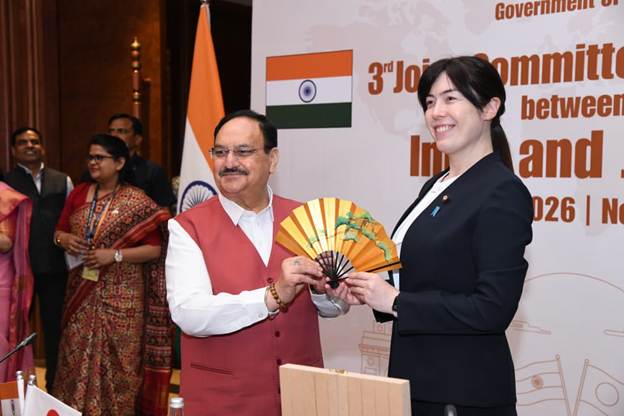
India and Japan have strengthened their bilateral partnership by exchanging a Memorandum of Cooperation (MoC) in the fields of health research and medical devices. The agreement was signed during a high-level meeting in New Delhi between Union Minister of State for Science and Technology Dr. Jitendra Singh and Japan’s Minister of State for Science and Technology Policy, Kimi Onoda. The move is aimed at boosting collaboration in healthcare innovation, advanced medical technologies, and scientific research.
The Memorandum of Cooperation was exchanged among the Indian Council of Medical Research (ICMR), the Department of Science and Technology (DST), and Japan’s Agency for Medical Research and Development (AMED). Through this partnership, both countries plan to promote joint research programmes, capacity building initiatives, and structured funding support in the healthcare and medical device sectors.
During the discussions, Dr. Jitendra Singh highlighted the complementary strengths of the two nations. He noted that Japan brings advanced technological expertise while India contributes a large pool of skilled scientific and technical talent. According to him, this synergy can help accelerate innovation in frontier technologies and convert research into practical solutions that benefit society.
Japan’s Minister Kimi Onoda also emphasized the importance of the collaboration, pointing out that Japan’s strengths in advanced manufacturing, artificial intelligence, and computational technologies align closely with India’s rapidly expanding innovation ecosystem. She expressed confidence that the agreements would deepen cooperation in research, industrial applications, and technology deployment.
Apart from healthcare cooperation, the meeting also witnessed the signing of a Letter of Intent on Quantum Science and Technology between Japan’s Cabinet Office and India’s Department of Science and Technology. This reflects the broader strategic partnership between the two countries in emerging technologies such as quantum computing, artificial intelligence, advanced computing, and digital innovation.
The two sides also discussed initiatives related to researcher mobility, innovation platforms, and academic collaborations. Programmes enabling Indian researchers to undertake collaborative projects and industry internships in Japan are expected to further strengthen scientific exchange and skill development between the countries.
Healthcare cooperation between India and Japan has expanded steadily in recent years. Earlier this week, both countries reaffirmed their commitment to strengthening healthcare systems during the 3rd Joint Committee Meeting on Healthcare held in New Delhi. Discussions covered areas such as digital health, cancer screening, medical technology, pharmaceutical manufacturing, and resilient healthcare supply chains.
Experts believe the latest agreements could significantly benefit India’s growing medical device manufacturing sector. Japan is globally recognized for high-quality medical technologies and precision manufacturing, while India offers scale, affordability, and a rapidly developing healthcare market. Increased cooperation may encourage technology transfer, joint manufacturing ventures, and research partnerships that improve healthcare accessibility and innovation.
Overall, the India–Japan cooperation marks another important step in strengthening scientific and healthcare ties between the two nations. By combining technological expertise, research capabilities, and industrial collaboration, both countries aim to advance innovation in health and medical devices while contributing to more resilient and future-ready healthcare systems.