
















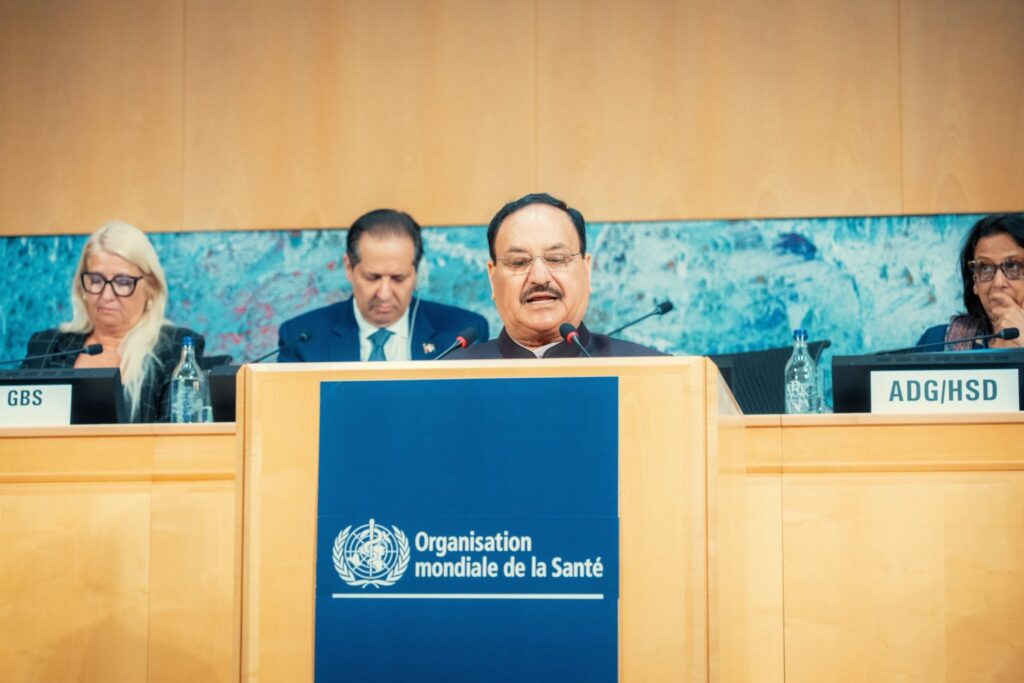
Union Health Minister Jagat Prakash Nadda reaffirmed India’s commitment to universal healthcare, digital health innovation, and global health cooperation while addressing the 79th World Health Assembly in Geneva. Speaking at the international gathering themed “Reshaping Global Health: A Shared Responsibility,” he highlighted India’s ongoing efforts to make healthcare more accessible, affordable, and technology-driven for its citizens.
During his address, Nadda stated that India’s healthcare expansion is based on a “whole-of-government” and “whole-of-society” approach. He said the country is rapidly moving toward Universal Health Coverage by strengthening public healthcare systems and expanding medical services to underserved populations. According to the minister, India’s healthcare policies are focused on ensuring equitable and people-centric care across urban and rural regions alike.
One of the key highlights of his speech was the progress made under the Ayushman Bharat initiative. Nadda informed delegates that India has operationalised more than 1.85 lakh Ayushman Arogya Mandirs across the country. These centres provide comprehensive primary healthcare services at the community level and play an important role in preventive healthcare, early diagnosis, and treatment.
The minister also emphasised the growing role of digital healthcare in transforming India’s medical ecosystem. He noted that the Ayushman Bharat Digital Mission has created over 880 million unique digital health IDs, enabling the maintenance of longitudinal health records and improving continuity of care. According to experts, digital health infrastructure can significantly improve efficiency, patient access, and coordination between healthcare providers.
Nadda highlighted the impact of Ayushman Bharat Pradhan Mantri Jan Arogya Yojana, describing it as one of the world’s largest public health assurance schemes. The programme currently covers nearly 600 million beneficiaries, especially vulnerable and economically weaker sections of society. The scheme aims to reduce out-of-pocket healthcare expenses and improve access to quality treatment for low-income families.
Addressing the future of healthcare technology, the minister spoke about India’s recently launched Strategy for Artificial Intelligence in Healthcare. He stressed that AI systems in healthcare must remain ethical, inclusive, and human-centric. According to him, the success of artificial intelligence in medicine depends on building systems that prioritise patient safety, trust, and equitable healthcare delivery.
Nadda also reiterated India’s role as the “Pharmacy of the World,” highlighting the country’s contribution to affordable medicines and vaccine production. Referring to the COVID-19 pandemic, he recalled that India supplied nearly 300 million vaccine doses to around 100 countries under the Vaccine Maitri initiative. He described the programme as a symbol of India’s commitment to global solidarity and international public health cooperation.
On the sidelines of the assembly, the Union Minister held bilateral meetings with health ministers from Bhutan, Nepal, and other countries to discuss collaboration in areas such as telemedicine, digital healthcare, pharmaceuticals, and skill development. India also expressed willingness to share best practices in digital health systems and affordable healthcare delivery with partner nations.
Experts believe India’s participation at the World Health Assembly reflects its growing influence in shaping global healthcare policy. The country’s emphasis on affordable healthcare, digital innovation, and international cooperation is increasingly being recognised as an important model for developing nations aiming to strengthen public health systems and improve healthcare access for all.