













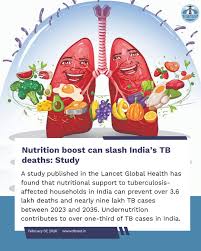
A major study published in The Lancet Global Health has revealed that nearly seven lakh tuberculosis (TB) cases in India during 2023 could have been prevented if undernutrition had been eliminated. The findings have intensified calls from public health experts to make nutrition a central pillar of India’s TB elimination strategy.
According to the study, undernutrition accounted for nearly 28.6 per cent of adult TB cases in India. Researchers explained that adults with a body mass index (BMI) below 18.5 are at a significantly higher risk of developing active tuberculosis because poor nutrition weakens the immune system’s ability to fight infection. India, which carries the world’s highest TB burden, remains especially vulnerable because of widespread malnutrition and poverty in many regions.
Professor Pete Dodd from the University of Sheffield, one of the researchers associated with the study, estimated that removing undernutrition entirely could have prevented around 7,12,000 TB cases in India in 2023 alone. Researchers used mathematical modelling techniques to assess how reducing nutritional deficiencies could influence the country’s TB burden.
Health experts noted that tuberculosis is caused by the bacterium Mycobacterium tuberculosis, but infection does not always lead to disease. Many individuals carry the bacteria without symptoms because their immune systems keep it under control. However, when people suffer from insufficient calorie intake, protein deficiency, or lack of essential micronutrients, immunity weakens and the risk of developing active TB increases substantially.
The report has renewed attention on nutrition-based interventions already tested in India. Experts pointed to the Indian Council of Medical Research-backed RATIONS trial, which demonstrated that providing food support to families of TB patients significantly reduced the risk of infection. The trial found that nutritional support, including rice, pulses, oil, milk powder, and micronutrient supplements, lowered the incidence of tuberculosis by nearly 49 per cent among household contacts of TB patients.
Former WHO Chief Scientist Dr. Soumya Swaminathan stated that more than 40 per cent of TB cases in India are linked to undernutrition. She stressed the need for stronger public distribution systems and targeted nutritional programmes in districts with high malnutrition levels. According to experts, improving access to protein-rich food and balanced diets may become one of the most effective tools for reducing TB cases in vulnerable populations.
Researchers also highlighted that nutritional support can reduce TB-related deaths and improve treatment outcomes. Earlier findings from the RATIONS trial showed that early weight gain among underweight TB patients significantly lowered mortality risk during treatment. Experts believe systematic nutritional assessments should become part of standard TB care across India.
Despite improvements in TB detection and treatment, India continues to face major challenges in eliminating the disease. Government data shows TB incidence and mortality have declined over recent years, but the country still contributes a large share of global TB cases. Public health specialists argue that medical treatment alone cannot eliminate tuberculosis unless broader social issues such as hunger, poverty, sanitation, and healthcare access are addressed simultaneously.
Experts concluded that tackling undernutrition could become one of the most impactful and cost-effective strategies for reducing India’s TB burden. They emphasised that strengthening nutrition programmes, improving food security, and supporting vulnerable communities are essential steps toward achieving the country’s long-term TB elimination goals.