













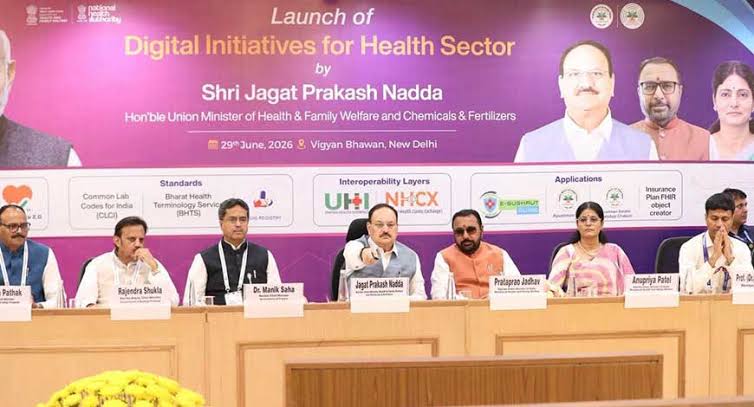
The Union Ministry of Health and Family Welfare has unveiled Aarogya Setu 2.0, a significantly upgraded version of the digital platform that aims to transform healthcare delivery by offering citizens a unified gateway to manage health records, access government healthcare services and interact with digital health systems. The initiative marks a major step in strengthening India’s Digital Public Infrastructure for Health under the Ayushman Bharat Digital Mission (ABDM).
Launched by Union Health Minister Jagat Prakash Nadda at Vigyan Bhawan in New Delhi, Aarogya Setu 2.0 has evolved from its original role as a COVID-19 contact-tracing application into a comprehensive Personal Health Record (PHR) platform. The revamped application enables users to create and manage their Ayushman Bharat Health Account (ABHA), securely store and share medical records with consent, and access a wide range of healthcare services through a single interface.
The new platform is designed to simplify healthcare access by integrating multiple services that were previously spread across different applications. Citizens can book outpatient appointments, make digital hospital payments, access laboratory reports, prescriptions and diagnostic records, and manage health information for family members. The app also supports integration with wearable health devices, allowing users to monitor health parameters and maintain continuous digital health records.
Alongside Aarogya Setu 2.0, the ministry launched several complementary digital initiatives aimed at creating an interoperable healthcare ecosystem. These include the Ayushman App, the AI-powered Ayushman Sarathi chatbot, e-Sushrut Clinic for digitising clinical practices, the National Health Claims Exchange (NHCX) for seamless health insurance claim processing, and new digital health standards such as the Bharat Health Terminology Service and Common LOINC Codes for India. Together, these initiatives seek to improve efficiency, transparency and data exchange across public and private healthcare providers.
A key feature of the upgraded platform is its focus on interoperability. By enabling healthcare providers, laboratories, hospitals and insurers to exchange health information through standardised protocols, the government aims to reduce paperwork, eliminate duplication of medical records and ensure faster access to patient information whenever required. The digital infrastructure also supports consent-based sharing of health data, allowing individuals to retain control over their personal medical information.
Artificial intelligence has also been integrated into the new platform to provide personalised health insights. Users can receive AI-enabled summaries of their medical information and health trends, helping them better understand their health status and make informed decisions. The ministry believes that AI-driven tools will enhance preventive healthcare while improving patient engagement and continuity of care.
The National Health Claims Exchange introduced as part of the digital package is expected to simplify insurance claim settlements by creating a common digital platform for communication between hospitals, insurers and government health schemes. This is expected to reduce processing time, improve transparency and minimise administrative delays in claim approvals.
Addressing the launch event, Health Minister J.P. Nadda said the government’s vision is to make healthcare more accessible, connected and citizen-centric through technology. He noted that digital platforms such as Aarogya Setu 2.0 would help strengthen healthcare delivery by improving access to medical records, streamlining services and enabling better coordination among healthcare providers. The new initiatives are expected to play a central role in expanding affordable, efficient and technology-driven healthcare across the country while supporting India’s broader digital transformation agenda.