






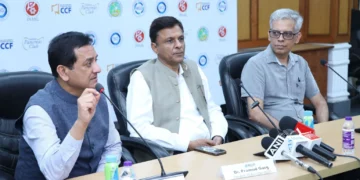










India has introduced a Health Terminology Service (HTS) as part of its ongoing efforts to strengthen the country’s digital healthcare ecosystem and improve the exchange of medical information across healthcare platforms. Launched by the Ministry of Health and Family Welfare in collaboration with the National Health Authority (NHA) and the National EHR Standards Resource Centre (NRCeS), the service aims to establish a common language for health data, enabling seamless communication between hospitals, laboratories, digital health applications and government health systems.
The Health Terminology Service is designed to standardise medical terms, clinical codes and healthcare vocabularies used across the country. By ensuring that different healthcare providers use consistent terminology, the platform will reduce inconsistencies in patient records, improve interoperability between digital systems and support more accurate diagnosis, treatment and data analysis. The initiative is expected to play a key role in strengthening India’s Digital Public Infrastructure for Health.
The newly launched service aligns with the government’s broader vision of building a connected digital health ecosystem under the Ayushman Bharat Digital Mission. Standardised terminology allows healthcare professionals and digital platforms to exchange patient information without errors caused by differences in naming conventions or coding systems. This will make it easier for patients to receive continuous care across multiple healthcare facilities while reducing duplication of medical records and improving clinical decision-making.
The Health Terminology Service is one of several digital initiatives introduced by the ministry to modernise healthcare delivery in India. Alongside HTS, the government has rolled out citizen-facing applications, interoperable health standards, digital health record solutions and other technology platforms that support better healthcare access and more efficient service delivery. These initiatives are intended to improve coordination among healthcare providers while making digital health services more accessible to citizens.
According to the ministry, adopting common health data standards is essential for creating a robust healthcare information network. The Health Terminology Service supports internationally recognised coding systems and standard medical vocabularies, enabling healthcare institutions to maintain consistent and structured electronic health records. This standardisation is expected to enhance clinical documentation, facilitate health research, improve public health reporting and support policy planning through reliable health data.
The platform will also benefit healthcare technology developers by providing standardised terminology that can be integrated into electronic health record systems, hospital management software and digital health applications. Uniform standards simplify software development, improve compatibility between platforms and enable healthcare providers to exchange information securely and efficiently across different systems.
Government officials believe that stronger interoperability will ultimately improve patient care by ensuring that accurate medical information is available whenever and wherever it is needed. The initiative is also expected to reduce administrative burdens, minimise documentation errors and support faster processing of healthcare services and insurance-related workflows. By creating a common framework for health information exchange, India aims to accelerate the adoption of digital healthcare technologies across both public and private sectors.
The launch of the Health Terminology Service marks another milestone in India’s digital health transformation. By establishing standard medical terminology and promoting interoperable health systems, the initiative seeks to improve healthcare quality, strengthen data-driven decision-making and create a more integrated, efficient and patient-centric healthcare ecosystem for the future.